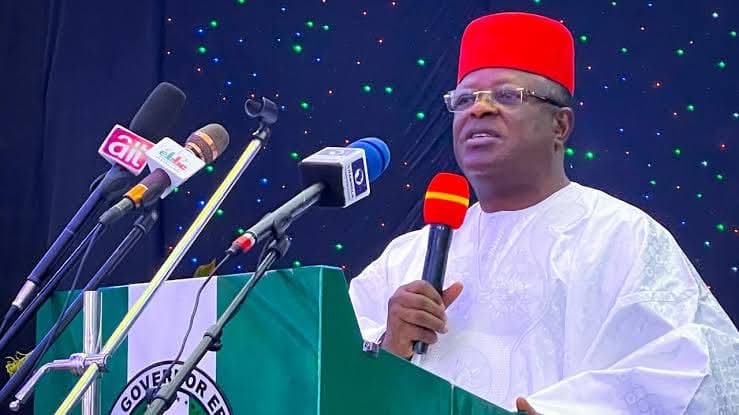

The Federal Government says it is constructing roads across the country designed to last between 50 and 100 years, thanks to new engineering standards and modern construction techniques.
The Minister of Works, Engr. David Umahi, made the declaration on Tuesday during an inspection visit to the Abuja–Kaduna–Zaria–Kano Expressway (Section One) rehabilitation project.
Umahi said the ministry has adopted innovative construction methods and materials that guarantee durability and sustainability under Nigeria’s diverse climatic and traffic conditions.
“You cannot achieve a better California Bearing Ratio (CBR) by simply bringing laterite on the road,” the minister explained.
“The existing subgrade, which has consolidated over years of traffic, has a stronger bearing capacity than a new one. That is why we are changing the approach, we are insisting on milling, stabilising, and strengthening, rather than removing old asphalt layers and replacing them with new materials.”
He commended the contractor, Messrs Infiouest International Limited, for the quality of work done so far, describing the design and engineering methods as among the most advanced in Nigeria’s road construction history.
According to Umahi, the new approach prioritises long-term road performance.
“Wherever we have potholes within the carriageway, we don’t just patch them. We treat the entire section using a stone base and, where necessary, stabilise it with cement,” he said.
“On the shoulders, we excavate about 10 centimetres below the existing asphalt, refill with a stone base slightly above the level, and compact properly. This ensures stability and prevents water from undermining the structure.”
He stressed that proper milling, concrete reinforcement, and rigid pavement design are now central to the ministry’s engineering policy.
“Our design now prioritises rigid pavement for major highways, while flexible pavements are being phased out gradually. Where asphalt is used, we introduce concrete shoulders to enhance strength and prevent premature failure,” Umahi stated.
“The goal is to ensure that no section of the road fails prematurely.”
He warned contractors and engineers against tampering with structurally sound asphalt layers, emphasising that recycled asphalt, when properly treated, can perform for decades.
“Asphalt has a designed lifespan of about 25 years. When milled and recycled properly, it can serve even longer. We must adopt international best practices and stop unnecessary replacement of strong materials,” he advised.
Umahi reiterated the government’s resolve to ensure all ongoing projects meet the highest quality standards, reduce maintenance costs, and deliver long-term value to Nigerians.
“We are building roads that will stand the test of time, roads that will last 50 to 100 years, save public funds, and promote economic growth,” he said.
The Minister of State for Works, Bello Muhammed Goronyo, reaffirmed that President Bola Ahmed Tinubu’s administration, under the Renewed Hope Agenda, remains committed to transforming Nigeria’s road infrastructure.
He praised Umahi’s dedication, describing him as a hands-on leader who inspires young engineers and promotes accountability in public works.
Engr. Olufemi Adetunji, the Director of Highways (Special Projects, North), also commended the pace and quality of work, noting that Umahi’s frequent inspection visits have improved both supervision and delivery timelines.
The Chairman of Infiouest International Limited, Mr. Joseph Aboue Jaoude, disclosed that the company has deployed over 300 pieces of equipment to the project to ensure efficiency and timely completion.
Meanwhile, Dr. Abiodun and Hon. Abdullahi Tanko Yakasai, Special Assistants to the President on Community Engagement (North Central and North West Zones), applauded the administration’s efforts, describing the progress as evidence of the government’s commitment to quality infrastructure and national development.