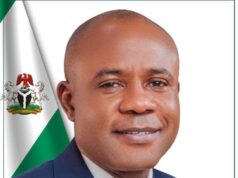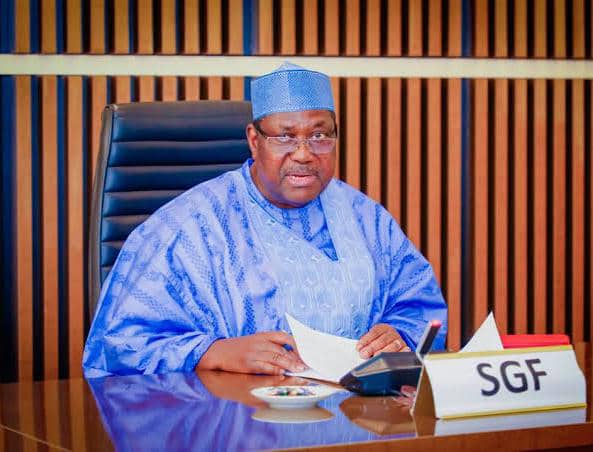

Secretary to the Government of the Federation (SGF), Senator George Akume, has expressed confidence that Nigeria will soon be removed from the United States’ Country of Particular Concern (CPC) list, a designation tied to religious freedom concerns.
Speaking at the second triannual meeting of the Nigeria Inter-Religious Council (NIREC) in Abuja, Akume said Nigeria is currently navigating a fragile period marked by divisive political rhetoric, insecurity, and declining trust among religious communities, tensions he said recently came close to triggering a religious crisis.
Akume explained that the U.S designation spurred extensive diplomatic efforts and internal reforms aimed at clarifying global misconceptions about Nigeria’s security and religious landscape.
He noted that President Bola Ahmed Tinubu has set up a new U.S–Nigeria Joint Working Group on Security, with NIREC expected to contribute significantly through non-military, dialogue-driven peace strategies.
While acknowledging progress, he said the restoration of mutual trust between Christians and Muslims remains the most urgent challenge.
He urged religious leaders to address harmful rhetoric and rebuild collaboration, unity, and peaceful coexistence.
Citing recent violent incidents stretching from Benue to Kwara, and attacks in Kebbi, Niger, and Zamfara, Akume said security agencies are intensifying rescue operations and arrests.
However, he stressed that public narratives often falsely portray the violence as a war between religions.
According to him, both Christians and Muslims have suffered devastating losses from insurgency, banditry, and communal conflict.
He appealed to Nigerians to avoid framing violence through a religious lens, warning that such narratives deepen suspicion and erode national cohesion.
“The issue is not to compare which group has suffered more,” he said.
“Violence in Nigeria is complex and not one-sided. Every killing wounds the whole nation. An interfaith approach is the only sustainable path to peace.”
Akume reaffirmed President Tinubu’s commitment to securing all communities and insisted that while international partnerships are welcome, “Nigeria must craft Nigerian solutions.”
He outlined priority areas where government and religious leaders must collaborate: inclusive policymaking, conflict-early-warning mechanisms, interfaith peacebuilding, justice, and the education of young people against hate speech and extremism.
The CAN President and NIREC Co-Chairman, Archbishop Daniel Okoh, described the meeting as timely, noting that insecurity, ranging from banditry to kidnapping and violent extremism, continues to devastate communities nationwide.
He warned that the resulting fear and displacement are crippling the economy: farmers cannot reach their farmlands, traders face mounting risks, and investors are discouraged by instability.
Okoh commended the Tinubu administration’s recent efforts to strengthen the security apparatus, but urged government to intensify its interventions.
He said religious leaders also bear a moral responsibility to rebuild trust among communities and promote peaceful coexistence.
He emphasised that peace cannot be achieved without justice: attackers and their sponsors must face the law, victims must be supported, and all groups must feel equally protected.
Co-Chairman of NIREC and Sultan of Sokoto, His Eminence Muhammadu Sa’ad Abubakar III, urged religious leaders to be sincere in their engagement, saying interfaith dialogue is pointless if participants preach harmony publicly but promote division privately.
He reminded the audience that Nigeria is multi-religious, and that Sharia law applies solely to Muslims, just as other legal systems protect all citizens.
“Our faiths teach truth, kindness, and love for our neighbours,” he said.
“We must live by these values.”